

The global maritime industry is under mounting pressure to reduce its carbon emissions. Regulatory regimes like those enforced by the International Maritime Organization (IMO) and the European Union Emissions Trading System (EU ETS) now require ships to manage and account for every ton of CO₂ they emit. To meet ship‑owner, lender and client expectations, fleet operators must adopt credible low‑emission strategies.
One of the most promising pathways is onboard carbon capture and storage (OCCS). Rather than waiting for widespread alternative‑fuel infrastructure, OCCS allows ships to continue using existing fuels while capturing the CO₂ emits and storing it onboard until off‑loading is possible. But OCCS systems pose a spatial challenge: the CO₂ storage tanks consume vessel space that could otherwise generate revenue. That is where lattice pressure vessel (LPV) technology enters the equation, offering a way to reclaim space, increase revenue potential and support decarbonisation simultaneously.
What Is Onboard Carbon Capture and Why It Matters
Onboard carbon capture systems consist of three parts: a capture unit integrated with the vessel’s exhaust, a processing system that cools and liquefies the carbon dioxide, and a tank that stores the liquefied gas until offloading is available at port.
Each ton of liquefied natural gas burned onboard generates around 2.76 tons of carbon dioxide. That creates a major need for space efficient storage. For many operators, OCCS is the fastest way to reduce emissions without waiting years for port side fuel infrastructure. It is also relevant across ship types—container ships, bulk carriers, RoRo vessels, and cruise ferries alike.
The Spatial Problem: LCO2 Storage Takes Up Valuable Space
The biggest drawback of onboard carbon capture is space. Cylindrical and bilobe tanks are widely used but they do not match the rectangular and modular design of most cargo spaces. These traditional tank shapes create large areas of unused space, especially below deck, and directly reduce cargo capacity. On a container ship, that often means forfeiting container slots, which translates into lost revenue.
As the demand for fuel alternatives grows, so does the size of required storage tanks. Unless a better storage solution is used, OCCS can become a barrier to profitability instead of a pathway to compliance.
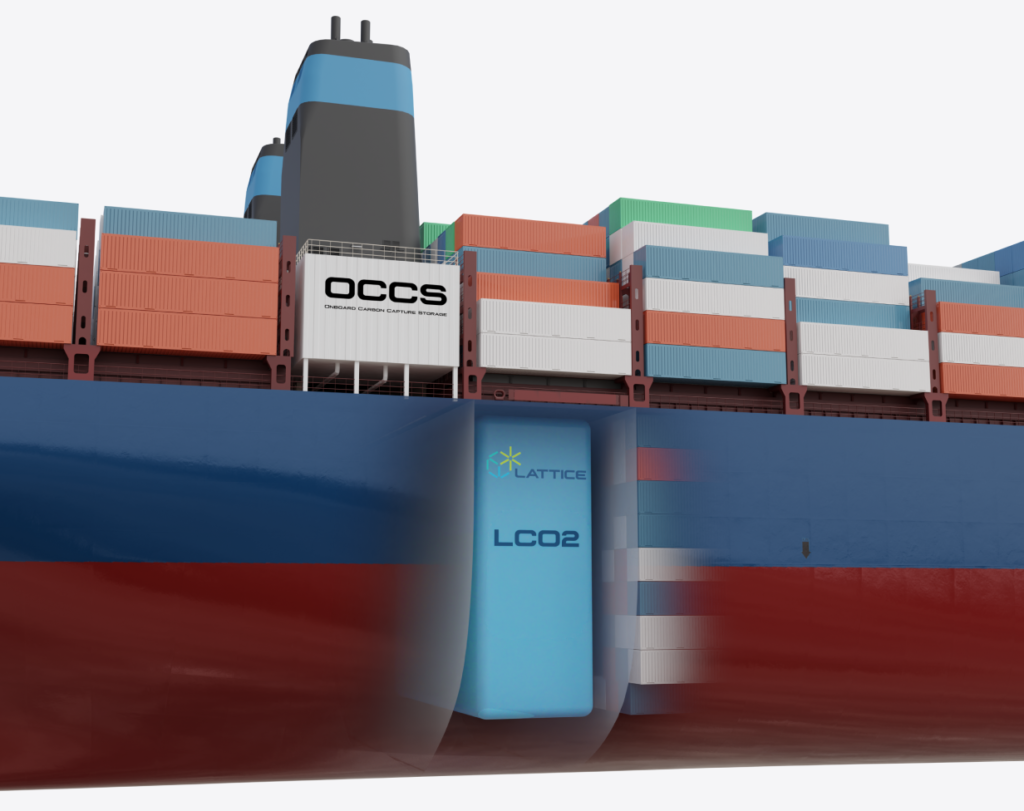
The LPV Advantage: Designed for OCCS Integration
LPV tanks are designed to solve the space problem. Their prismatic, boxlike design allows for maximum volume utilization within the hull’s available geometry. Instead of fitting the ship around the tank, LPV tanks are designed to fit the ship.
They can increase volume utilization from around 53 percent with a cylindrical tank to over 90 percent. LPV tanks also offer flexibility. They can be placed in low value or unused areas of the hull, such as the bow or beneath noncritical decks. This means cargo space is protected, and operations remain efficient.
Additionally, LPV tanks can be customized for different pressure ratings and prepared for future fuel types like ammonia or hydrogen. This flexibility ensures that the investment in OCCS is ready not just for today’s challenges but also for tomorrow’s regulatory and environmental demands.
Case Study: 9400 TEU Vessel Saves 199 TEUs and Gains Seven Million USD Per Year
A 9400 TEU container vessel operating between Europe and the Gulf was assessed for OCCS integration. With no ability to discharge carbon dioxide during the voyage, the ship required around 9880 cubic meters of onboard tank volume. Using cylindrical tanks, volume efficiency was limited to just over 50 percent.
By switching to an LPV solution, tank utilization increased to 90 percent. This freed up space equivalent to 199 additional containers. Over twelve round trips per year, with a value of fifteen hundred dollars per container slot, the result was over seven million dollars in added annual revenue. Across a typical twenty year vessel life, the total revenue gain exceeded one hundred forty three million dollars.
Derisking Compliance and Future Operations
OCCS equipped with LPV tanks helps ship owners reduce exposure to carbon pricing systems like the EU ETS. Rather than paying for every ton of carbon emitted, operators can now capture and store it onboard with minimal cargo loss. This strengthens environmental, social, and governance performance and helps satisfy the expectations of stakeholders and financiers.
LPV technology also supports fuel transitions. As carbon neutral fuels become more available, LPV tanks can be adapted or repurposed to store alternative fuels safely, allowing the vessel to stay compliant without compromising its commercial operations.
Summary: More Cargo, Less Carbon, Faster Return on Investment
Maritime decarbonization is no longer optional—it is a financial and regulatory necessity. OCCS systems help solve the emissions challenge today, while LPV tanks make these systems profitable and scalable.
By integrating LPV into OCCS design, operators protect their cargo space, unlock new revenue streams, and create a flexible platform for future fuel transitions. This is the smart, fast, and financially sound way to meet emissions targets without sacrificing profitability.
FAQs
What ship types can use LPV tanks for OCCS?
Any vessel with significant fuel consumption and space constraints can benefit. This includes container ships, car carriers, bulk carriers, passenger ferries, and offshore support vessels.
Can LPV tanks be retrofitted on existing vessels?
Yes. LPV tanks can be tailored to fit available spaces and integrated into both newbuild and retrofit projects with minimal disruption.
Is LPV compatible with future fuels like ammonia?
LPV tanks are highly adaptable and can be built to meet the pressure and safety requirements of low carbon and zero emission fuels such as ammonia and hydrogen.
How do LPV tanks affect vessel range or cargo capacity?
They increase storage volume within the same footprint, helping preserve or expand vessel range while freeing up more room for revenue generating cargo.
Are LPV tanks approved by classification societies?
Yes. LPV technology meets international safety standards and is approved by all major classification bodies including ASME and others.